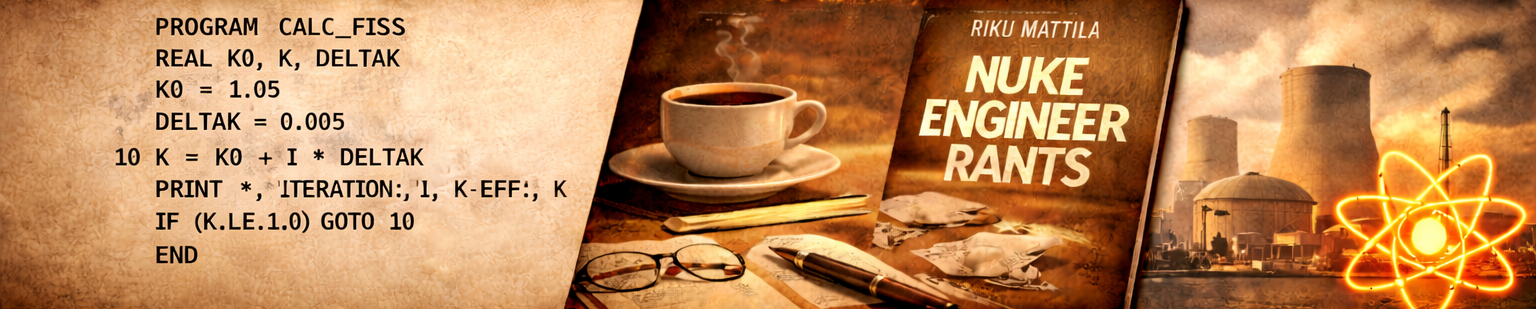
This is not a textbook, and it is not a memoir.
It is a set of observations from a career spent inside nuclear engineering—design reviews, licensing work, and the steady effort to understand how systems behave when conditions drift outside their assumptions.
Most writing on nuclear safety focuses on structure: defense-in-depth, redundancy, classification. Necessary, but not sufficient. The failures that matter rarely come from missing components. They come from connections—dependencies that were assumed away, or interactions that only appear under stress.
None of the major accidents have been design-basis events. They began as something ordinary and progressed along paths the design quietly allowed.
The tone is direct on purpose. Engineering can handle complexity, but not obscurity. If a system depends on a valve, it depends on a valve. If independence is claimed, it should exist physically, not just on paper.
These are not comprehensive arguments. They are fragments—things that used to be said aloud in passing, now written down.
The aim is not agreement. It is clarity.